Seakeeper 9 Installation Manual (90222-12); S/N 9-254-5731 to Current
4.2 Cooling System Considerations
- The installer is responsible for supplying a dedicated positive-displacement seawater pump (or electric isolation valve and centrifugal pump) and associated plumbing. Seawater connections on the Seakeeper heat exchanger mate with ¾ in. (19 mm) hose. An optional seawater pump can be purchased through Seakeeper, P/N 30331.
- Unintended seawater flow from the seawater pick-up during underway operations is unacceptable and may cause stress on internal components. Unintended flow should be mitigated through an inlet electric ball valve. Continuous cooling flow from shared through-hull plumbing, a centralized chiller, or a cooling system is unacceptable for Seakeeper models.
- There is no need to disconnect the hose from the glycol pump except to replace the pump. In this case, provision will need to be made to catch the draining glycol, as the plumbing is disconnected. Use caution to avoid breaking plastic hose connections on the pump casing.
- The seawater pump is powered by DC Seawater Pump Output cable on the Seakeeper 9, as outlined in Electrical Installation Section 3.2.
- This pump must operate on 24 VDC, 10 A power. Pumps requiring other voltages or higher current can still be controlled by using this supply to trigger an installer-supplied relay, but a separate source of power must be provided.
- A dedicated through-hull fitting should be installed for each Seakeeper to ensure sufficient seawater flow to that unit onboard the vessel.
- It is recommended that the seawater pump is located below the waterline, as close to the vessel’s baseline as practically possible, to maintain positive inlet pressure on the pump in all operating conditions.
- Install 1 in. electric ball valve (P/N 20762) and two 1 in. to 3/4 in. fittings from kit 90970 shown in Figure 42.
- Install electric ball valve in suction line of pump between the strainer and the seacock valve and within 40 in. (1 m) of seawater pump.
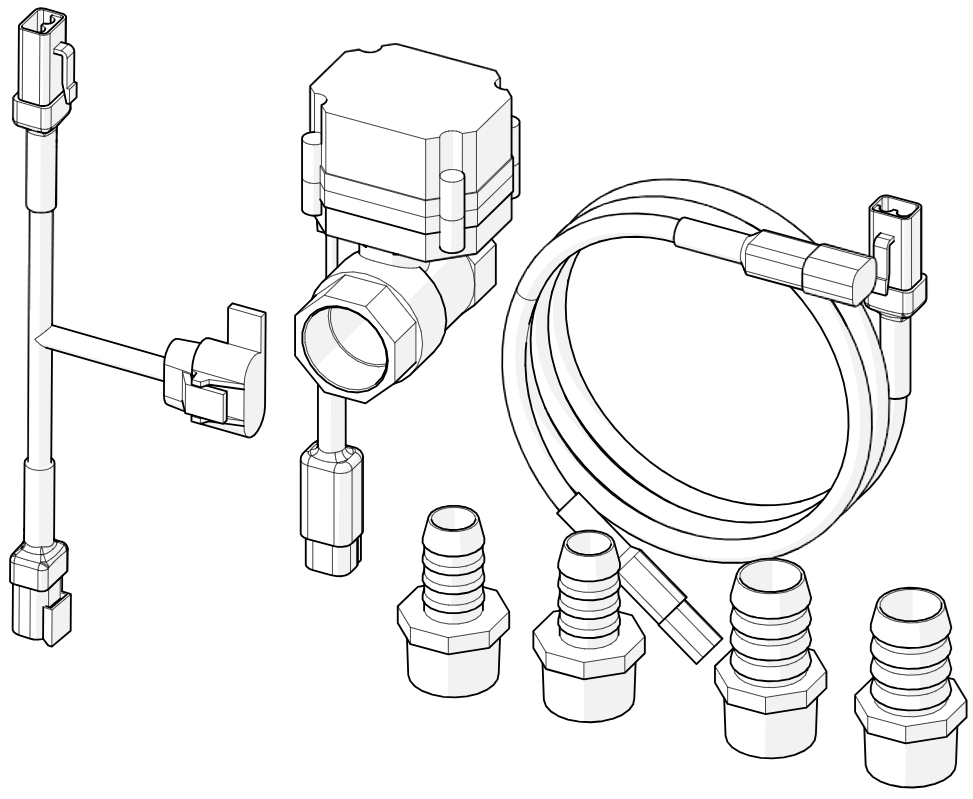
(P/N 90970)
- Seakeeper recommends the seawater pump be located below the waterline, as close to the vessel’s baseline as practically possible, to maintain positive inlet pressure on the pump in all operating conditions.
- A self-priming seawater pump may be required to maintain water flow in all underway conditions. Cavitation can occur at the seawater inlet and potentially cause an air-lock condition restricting seawater flow to the heat exchanger.
- Vented loops are optional and should be considered only with centrifugal-style pumps. Self-priming or positive displacement style pumps do not require a vented loop; this includes Seakeeper P/N 30331.
- Maximum seawater pressure in the heat exchanger is 20 psi (1.4 bar)
- Seawater flow requirement through the heat exchanger is 4 GPM (15.1 LPM) minimum and 8 GPM (30.3 LPM) maximum under all operating conditions of the boat. When sizing the seawater pump, the installer should account for losses in the raw water plumbing. In addition to initial operation at the dock, new Seakeeper installations should be checked to ensure they meet flow requirements while the vessel is at speed. Flows above 8 GPM (30.3 LPM) could shorten heat exchanger life.